
Yemen Embassy UK: A Guide to Legalising Commercial Documents
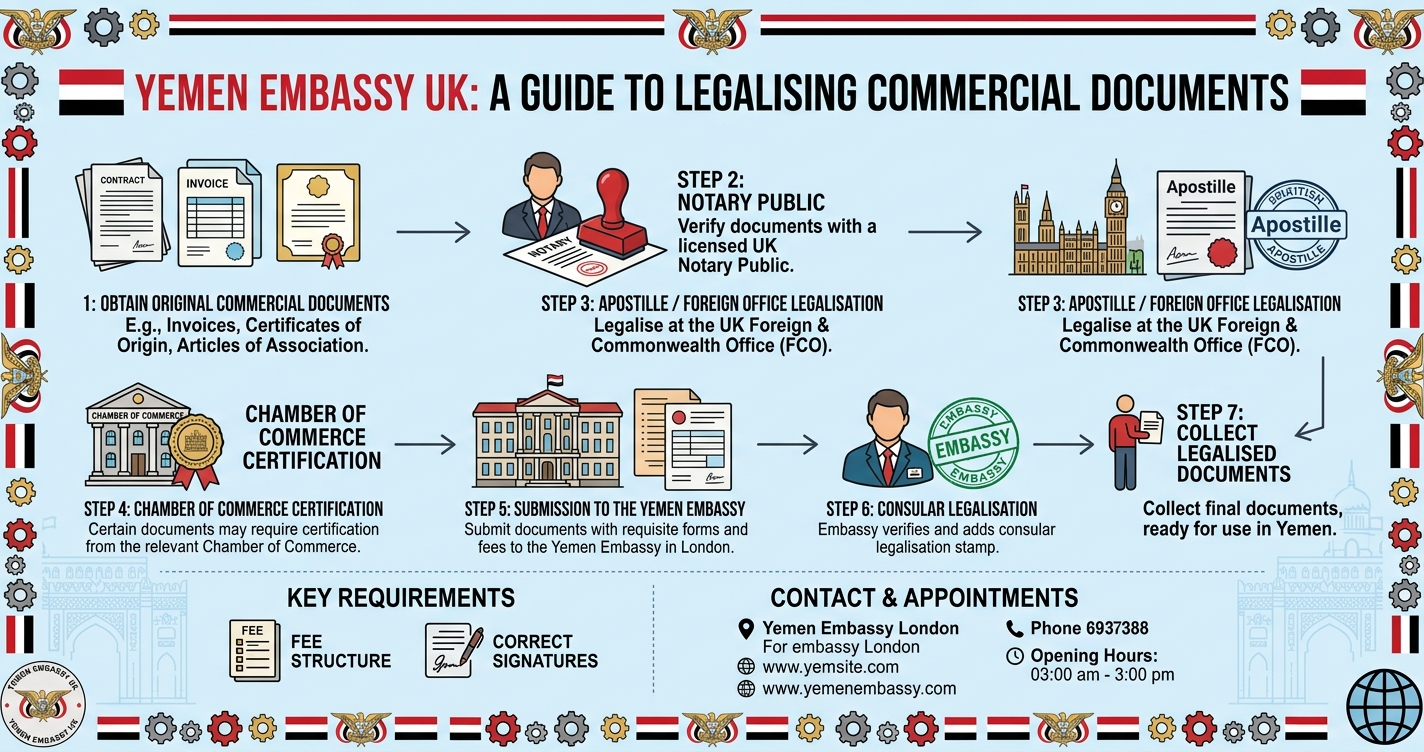
When UK businesses need to use commercial documents in Yemen, the paperwork may need to go through a legalisation process before it can be accepted by the relevant authorities. Commercial documents such as contracts, certificates, company records, invoices, powers of attorney, and business agreements may require certification and further legalisation depending on their purpose.
Legalisation4you provides professional support for individuals and businesses dealing with document certification, apostille, and legalisation requirements. Understanding the process in advance can help businesses prepare their documents correctly and reduce the risk of unnecessary delays.
This guide explains the key steps involved in preparing commercial documents for use in Yemen and what businesses should consider when dealing with Yemen Embassy UK requirements.
What Is Commercial Document Legalisation?
Commercial document legalisation is the process of authenticating a document so it can be recognised for official use in another country. A document issued in the UK may not automatically be accepted by a foreign authority simply because it is genuine.
Depending on the document and its intended use, it may need to be certified, notarised, apostilled, and then submitted for further legalisation or attestation.
The exact requirements can vary according to the type of document, the organisation requesting it, and its intended purpose in Yemen. Checking the requirements before starting the process can help businesses avoid submitting unsuitable paperwork.
Which Commercial Documents May Need Legalisation?
Businesses may need to legalise different types of documents when dealing with organisations, partners, or authorities in Yemen.
Common examples include:
- Commercial contracts and agreements
- Certificates of incorporation
- Company registration documents
- Certificates of origin
- Powers of attorney
- Invoices and business records
- Export and trade documents
- Articles of association
- Board resolutions
- Financial and corporate documents
- Letters and declarations for business purposes
Not every document will follow exactly the same procedure. Some documents may require additional certification before they can proceed to the next stage.
Why Legalisation May Be Required for UK Businesses
Businesses operating internationally often need to prove that their documents are genuine and were issued or certified by an appropriate authority.
For example, a UK company establishing a commercial relationship in Yemen may need to provide corporate documents to a local organisation, government authority, financial institution, or business partner.
Without the appropriate authentication or legalisation, a receiving organisation may not accept the documents.
Using professional assistance can make it easier to understand which stages may apply to a particular document and where additional certification may be required.
Understanding Yemen Embassy UK Requirements
The requirements associated with the Yemen Embassy UK can depend on the nature of the commercial document and how it will be used in Yemen.
Before submitting paperwork, businesses should identify:
- The exact document being submitted
- Where the document was issued
- Whether certification or notarisation is required
- Whether an Apostille is needed
- Whether embassy legalisation or attestation applies
- Whether a translation is required
- Which authority will receive the document in Yemen
Requirements can change depending on the circumstances, so businesses should confirm the current requirements with the relevant authority before proceeding.
Step 1: Prepare the Original Commercial Document
The first step is to identify and prepare the correct original document.
Businesses should ensure that company names, registration numbers, dates, signatures, addresses, and other important information are accurate and consistent across the paperwork.
If a document contains errors or incomplete information, it may cause problems later in the legalisation process.
It is also important to determine whether the document is an original, an official copy, or a document that needs certification before it can be legalised.
Step 2: Arrange Certification or Notarisation Where Required
Certain commercial documents may need to be certified or notarised before further authentication can take place.
For example, a document signed by a company representative may require appropriate certification depending on its nature and intended use.
A professional notary or solicitor may be able to certify documents where appropriate. However, the correct certification depends on the document and the requirements of the receiving authority.
Businesses should avoid assuming that every commercial document follows the same procedure.
Step 3: Obtain an Apostille Where Applicable
An Apostille is a form of authentication used for documents intended for countries participating in the Hague Apostille Convention.
Depending on the document and the destination requirements, a UK-issued document may need an Apostille before further steps are taken.
The appropriate process depends on the type of document and how it has been issued or certified. Obtaining the correct authentication at the right stage can help prevent delays.
Step 4: Embassy Legalisation or Attestation
Where embassy legalisation is required, the relevant documents may need to be submitted according to the applicable requirements.
This stage is particularly important because businesses should ensure that the paperwork has been prepared correctly before submission. Incorrect certification, missing documents, or unsuitable copies may result in additional processing or delays.
Professional document legalisation support can help businesses understand the sequence of steps and prepare their paperwork accordingly.
Commercial Documents and Translation
Translation may also be required when UK commercial documents are being used in Yemen.
Documents such as contracts, company certificates, powers of attorney, and declarations may need to be translated depending on the requirements of the receiving organisation.
The translation requirements can vary, so businesses should confirm whether a certified or professionally prepared translation is necessary.
Legalisation4you can provide support with document translation alongside certification and legalisation requirements, helping businesses manage multiple stages through a more organised process.
Common Mistakes Businesses Should Avoid
Commercial document legalisation can become complicated when businesses overlook specific requirements.
Common mistakes include:
- Submitting photocopies when originals or certified copies are required
- Using incorrect or outdated company information
- Missing required signatures
- Failing to obtain certification before legalisation
- Assuming every document requires the same process
- Not checking translation requirements
- Leaving document preparation until the last minute
- Failing to confirm the destination authority’s requirements
Carefully checking the requirements before submission can help reduce avoidable problems.
How Professional Legalisation Support Can Help
International document procedures can involve several stages, particularly when commercial paperwork requires certification, Apostille, translation, or embassy legalisation.
Professional support can help businesses understand the process and identify which services may be appropriate for their documents.
Legalisation4you supports businesses and individuals with document legalisation requirements, including commercial documents intended for international use. Assistance may include document preparation guidance, certification support, Apostille services, translation, and legalisation.
This can be particularly useful for businesses handling several documents at the same time or dealing with international deadlines.
Why Choose Legalisation4you?
Legalisation4you provides professional support for businesses and individuals dealing with UK document legalisation requirements. From commercial contracts and company documents to certificates and powers of attorney, the team can help clients understand the appropriate preparation process.
Clients can benefit from:
- Commercial document legalisation support
- Apostille and certification assistance
- Professional document translation
- Guidance on international document requirements
- Support with personal and business documents
- Clear communication throughout the process
The aim is to make document preparation more straightforward while helping clients avoid common administrative mistakes.
How Long Does Commercial Document Legalisation Take?
The time required can vary depending on the document, the certification involved, the destination requirements, and the authorities processing the paperwork.
Some documents may require additional preparation before they can be submitted for legalisation. Businesses should therefore allow sufficient time, particularly when documents are needed for contracts, overseas business arrangements, registration, or other time-sensitive matters.
Starting the process early can provide more flexibility if additional certification or documentation is requested.
Final Considerations for Yemen Embassy UK Legalisation
Preparing commercial documents for use in Yemen requires careful attention to authentication and legalisation requirements. Depending on the circumstances, businesses may need to arrange certification, notarisation, an Apostille, translation, and further embassy-related procedures.
The most important step is to establish the exact requirements for the document before beginning the process. This can help businesses avoid unnecessary costs, rejected paperwork, and delays.
Legalisation4you provides professional support for businesses preparing UK documents for international use. If you need assistance with commercial document legalisation, certification, Apostille services, or translation, professional guidance can help you understand the appropriate next steps.
Frequently Asked Questions
1. Which commercial documents may require legalisation for Yemen?
Contracts, company documents, powers of attorney, certificates, invoices, declarations, and other commercial paperwork may require legalisation depending on their intended use.
2. Does every commercial document need an Apostille?
Not necessarily. The required process depends on the document and the requirements of the receiving authority. Businesses should confirm the current requirements before submitting paperwork.
3. Can commercial documents require translation?
Yes. Translation may be required when documents need to be presented in a particular language. The receiving organisation should confirm whether a certified or professional translation is necessary.
4. Why is document certification important?
Certification can help authenticate the document or signature before further legalisation takes place. The appropriate certification depends on the document and its intended use.
5. Can Legalisation4you help with commercial documents?
Yes. Legalisation4you provides professional support with document certification, Apostille, translation, and legalisation requirements for individuals and businesses preparing documents for international use.